The most-read words on your website
Quick announcement: My brand identity course, Tone Up, is currently going through an extensive update; I am adding even more case studies and break downs exploring the brand voices and brand identities of today’s market. If you’re a current student, thank you and bear with.
Phew. Let’s get into it.
TL;DR: Cookie banners are the most-read words on your website and yet the most underused opportunity to connect with your audience.
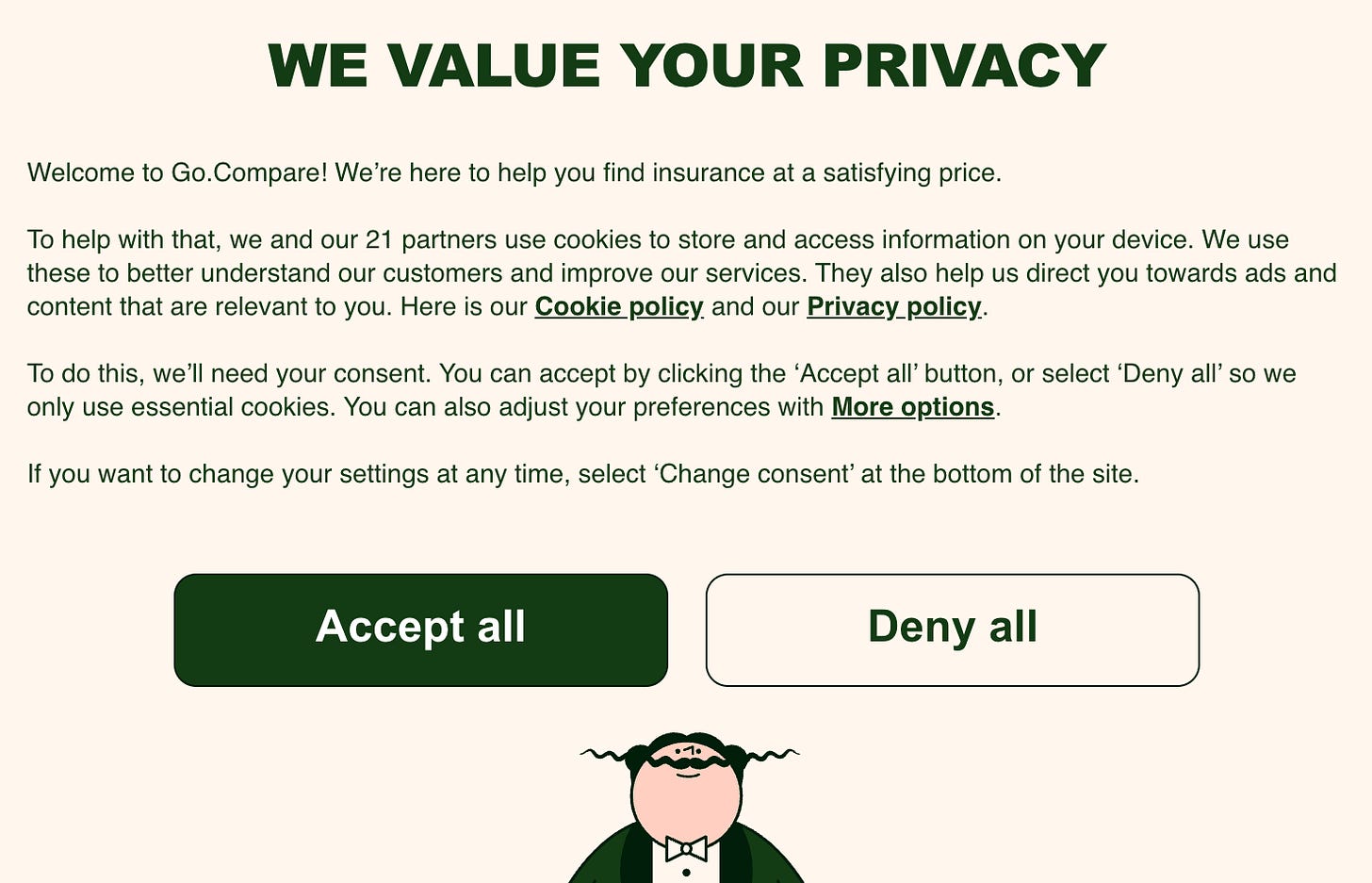
Let’s start with a question: What’s the first thing a visitor reads when they land on your website?
Your carefully crafted headline? The hero copy you rewrote fourteen times? The tagline you argued about in a workshop for three hours before someone said “what if we just slept on it” and you never spoke of it again?
Nope. It’s your cookie banner.
That grey-and-white pop-up that slides in from the bottom of the screen like a bouncer who’s not quite sure you’re on the list. The one that says something like: “We use cookies to enhance your browsing experience, analyse site traffic and personalise content. By clicking ‘Accept All’ you consent to our use of cookies in accordance with our Cookie Policy.”
Remember brand voice? Lovingly defined. Carefully documented. Yet still largely absent from the majority of cookie banners I see online.
So, how did we get here?
Well. GDPR arrived in 2018 like a strict supply teacher and everyone panicked. Legal teams were dispatched. Compliance consultants were hired. Cookie consent platforms were bolted onto websites with the urgency of people nailing boards over windows before a storm.
Nobody stopped to ask: wait, this is from legal, but shouldn’t it sound like us?
And so the result was that an entire generation of websites essentially copy-pasted their cookie banners from each other. Which means that right now, one brand’s cookie banner probably sounds identical to its biggest competitor’s. Or to the brand they’d least like to be compared to. And to the insurance broker in Wolverhampton.
Let’s talk about what these things actually say
I’ve been collecting cookie banners and T&Cs the way some people collect postcards, just a tad more depressing. Here’s the breakdown of what they’re really communicating, translated from legal beige into plain English:
“We use cookies to enhance your browsing experience.” Translation: We’re tracking you, but we’ve framed it as a gift.
“Strictly necessary cookies cannot be disabled.” Translation: We’ve pre-ticked the thing you can’t untick. Don’t look at it too hard.
“By continuing to use this site you agree to our Terms.” Translation: You haven’t agreed to anything. We know that. You know that. Let’s both pretend otherwise.
“We take your privacy seriously.” Translation: We are legally required to say this.

Starface added a cookie emoji which just feels kinda lazy tbh
And then there’s the T&Cs themselves. Those magnificent monuments to human endurance. Nobody reads them. Not even the lawyers who wrote them, I suspect, once they’ve been sufficiently revised by the lawyers who checked the lawyers’ work. They exist in a quantum state: simultaneously very important and completely unread.
Here’s the opportunity everyone’s missing
The thing is, cookie banners and T&Cs aren’t going anywhere. They’re legally mandated wallpaper. But wallpaper can be interesting.
Think about it. Your cookie banner is prime real estate. It’s literally the first thing on your site that a real human eyeball lands on. And most brands treat it like the small print on a parking ticket.
What if it sounded like you?
Not “we use cookies to enhance your browsing experience.” But (depending on your brand) something like:
“Before we go any further, some quick housekeeping. We use cookies to make this site work properly and to understand how people use it. That’s it. Pick what you’re comfortable with.”
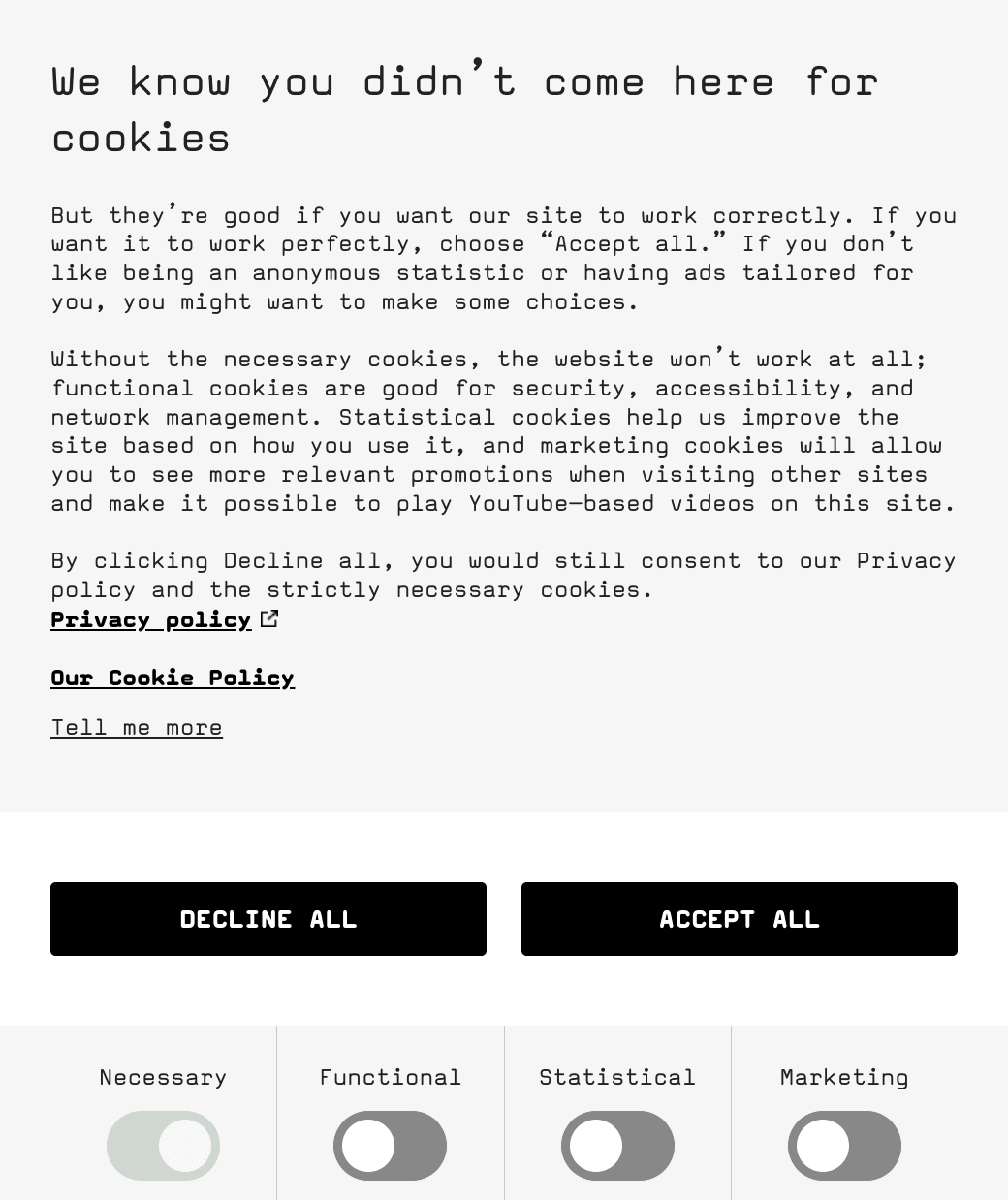
Or if you’re a bit more playful:
“Yep, cookies. We know. You can accept all of them, pick and choose, or just the essentials – totally up to you.”
Or if your brand is warm, trustworthy and welcoming, like Monzo:
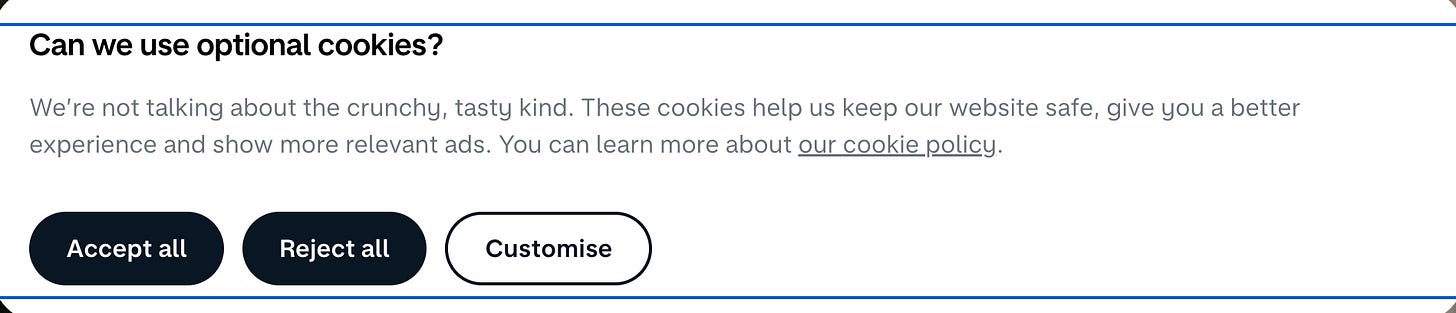
Same legal function, completely different feeling. Suddenly there’s a person behind the brand.
“Compliance will never allow it”
I hear this every time. And look, sometimes it’s true. Compliance teams exist for good reasons and I’m not here to pick a fight with anyone’s legal team.
But here’s what I’ve found: the resistance usually isn’t legal, it’s inertia. Nobody’s pushed back. Nobody’s made the case. The cookie banner got generated by a compliance tool in 2019 and nobody’s touched it since, because it’s not in anyone’s job description and there’s always something more urgent.
The brands who’ve done this well didn’t do it by ignoring their legal teams. They did it by working with them, establishing what the words need to do (inform, gain consent, cover their backs) and then finding ways to do that in a voice that doesn’t make their users feel like they’ve just received a court summons.
It’s the same principle that applies to every piece of brand communication. The message is fixed. The voice is yours to own.
The small print (which you will actually read, because I wrote it nicely)
Here’s the truth: the brands people love aren’t just the ones with beautiful websites. They’re the ones who sound like themselves everywhere. In the big moments and the boring ones. In the hero headline and the cookie banner.

Sorry Duolingo, I know you can do better than this
Because if your voice disappears the second things get functional, if it only shows up when someone’s designed a nice graphic to go with it, then it’s not really doing its job.
Your T&Cs don’t have to read like a legal team. Your cookie banner doesn’t have to sound like it was copy and pasted from IBM’s. These are chances, albeit small ones, yes, but real ones, to remind people who you are.
Take them.
That’s all for now.
👋
P.S. Seen a cookie banner or T&Cs that actually made you smile? I want to hear about it. Hit reply.
¹ I have not verified this statistic. It feels true.
² GDPR also spawned a generation of “we’ve updated our Privacy Policy” emails that achieved the impressive feat of being both urgent-sounding and completely ignored. A whole other article.
³ I’m defining “interesting wallpaper” loosely. I once saw a cookie banner with a scroll-activated confetti animation. It was horrible. Don’t do that.
The tools, tactics and thinking behind brilliant brand communication
Gab Lab is a space where brand builders and creatives can learn how to wield language with intention, creativity, and strategic bite.